Posts

24 March

Image
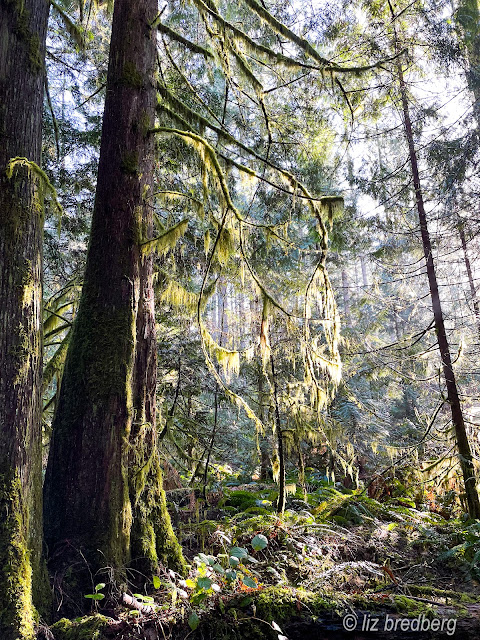
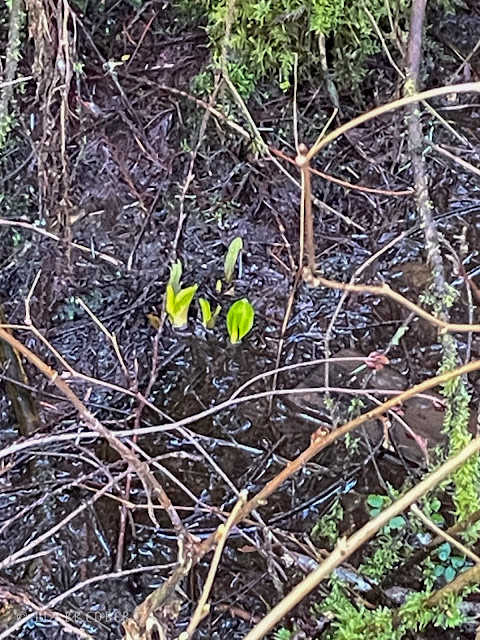
  Setting out this morning in dense fog along the shore, I’d expected limited visibility in the Forest and Wetlands.   To my delight, the fog had cleared inland, illuminating the cat-tail moss festooned on the trees and revealing a gloriously sunny forest. The path shows signs of spring.  Although new growth remains limited, buds and leaves are increasingly evident each week.  This huckleberry is definitely showing vigorous growth. Less lovely (at least to most of us), this slug should still be welcomed as the first of the season. The first salmonberry blossom has appeared. In the wetter patches of the forest, skunk cabbage is sprouting. I chanced to meet the very fine nature photographer, Deb Freeman, on the trail.  She greeted me happily with, "I've got something for you!" and she most certainly did have something wonderful: She had taken several photos of a Virginia rail in the Marsh, an uncommon, elusive, even secretive bird, very infrequently reported in th...
17 March

Image
  Gradually, spring is making its way into the Forest and Wetlands.  The frogs were in full voice this morning, celebrating the change of the season.       https://drive.google.com/file/d/1kEgrY6-12eF-hQS9O2krJc-B62u7uAg-/view?usp=sharing     It was, finally, a sunny morning, and the forest is becoming increasingly lush.  Skunk cabbage shoots are just appearing. A variety of mosses are emerging, some of which we hadn't seen before.  We'll hope for identification. We've only seen the moss below in one spot.  It seems uncommon for this area;  it will be worth monitoring its development as well as submitting it to iNaturalist. There were a couple of patches of birds-nest fungus among the mosses. I've observed the branches of this conifer before, thinking it was a western hemlock, but looking for the parent tree or cones to confirm my identification. Today I realised that it is actually an entire young tree, with the central trunk ...

9 March

Image
  I thought I'd found a "weather window" in the Hamilton Wetlands and Forest yesterday.  The morning looked rainy and windy, but by noon things appeared to have calmed down a bit. We made our way to the Forest, which was quite wet and mostly dark, although there were breaks in the clouds.  Moss continues to proliferate on logs and trees.  Downed trees continue in their role as nurseries for huckleberry vines. They also host slime molds, odd organisms, not fungus, plant, or animal, but with what appears to be memory and planning capacity.   Although the white blotches are less beautiful than the moss (at least to most of us), it's possible that the slime molds regard themselves as handsome and elegant.  Who knows? There are new fungi emerging along with lichen and luxuriant moss. iNaturalist tells me this is Hairy Curtain Crust, or "False Turkey Tails" It seems to thrive in the forest's dampness.   We're starting to wonder when the woodpecker ...

2 March

Image
  Mixed weather in the Wetlands and Forest.   Although the temperature was relatively mild, there was snow last night, and the paths were a mix of snow, mud and snowmelt. Mosses and trees were decked with snow.  Two mossy stumps looked as though they huddled together for warmth. The sun illumined mosses and snow.   After remarking on the dwindling fungus population in previous blogs, we found a striking growth climbing to the top of a dead tree. Two tiny mushrooms emerged from moss and snow. The mossy muppet had a cap of snow  today. We had an unhappy surprise at the Marsh. Somehow, the last section of the dock and the bench had both vanished.  We're not clear about what has happened, but the bench was a popular spot for folks (including us) to sit and admire the view.  Perhaps it will reappear.   We made our muddy way back, wondering what had happened to the dock, and what will happen in the future.

26 February

Image
  Spring is definitely approaching in the Wetlands and Forest, despite icy temperatures today.  There had been wild weather yesterday, and patches of hail remained. As we entered the forest, the light was a brilliant contrast to the darkness of the previous weeks. It struck and transfigured this huckleberry vine. My walking partner spotted and identified a rarity--hair ice emerging from downed alders.  Its occurence is linked with a specific fungus, lepidopsis effusa , which emits a chemical that enables strands of ice to emerge from downed wood at temperatures just below 0 C.  Here, its emergence is limited to fallen alder which has shed its bark.   This mossy stump is becoming a nursery for two little huckleberry  vines.   There were unmistakeable sounds of spring.  A pacific wren, still secretive, trilled its song, the first we've heard after the winter's chip notes.  Approaching the Marsh, we were greeted by an exuberant chorus ...